


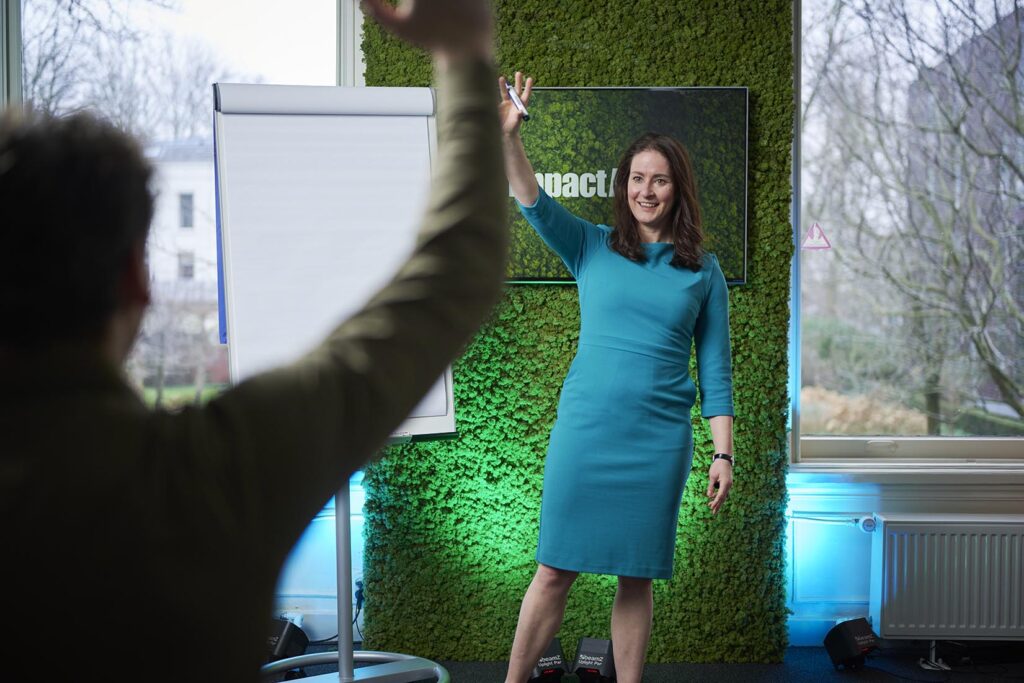
Support your teams in presenting their ideas with power, clarity, and credibility. Both verbally and non-verbally. Tailored to each participant’s style, they get personalized tips to enhance presentation skills.
Have you ever wondered why some people immediately capture attention when they speak, while others struggle to get their message across?
It’s rarely just about your words.
When you present, lead a meeting, pitch an idea, or have an important conversation, people don’t only listen to what you say. They also respond to how you say it.
The good news? You don’t need a special voice to make an impact.
Yes, I am here to encourage you… For you to become an effective communicator, you don’t need the deepest voice, the perfect pace, or a polished speaking style. Read along and discover how you can adapt your voice to your audience, message, and situation.
Think about the last presentation that truly held your attention.
The speaker probably didn’t talk slowly all the time or speak loudly from start to finish. Instead, they used variation:
• They sped up when sharing excitement.
• They slowed down to highlight an important point.
• They paused to let an idea sink in.
• They changed their emphasis to guide your attention.
That’s what effective communication looks like. Not a perfect voice, but a purposeful one.
If you want to communicate with more impact, start by paying attention to these five elements. Small adjustments can already make a noticeable difference in how your message is received.
Dare to slow down.
The parts of your message that you deliver more slowly often feel more important to your audience. People naturally associate a lower speaking tempo with a meaningful or serious message.
That doesn’t mean you should speak slowly all the time. In fact, that can have the opposite effect. The real skill lies in variation. By consciously alternating between faster and slower moments, you create rhythm, hold attention, and help your audience follow your story.
Your voice is more than sound. It’s part of your total body expression.
Your posture, facial expressions, movement, and voice work together. When they are aligned, you sound more energetic, engaging, and authentic.
A simple way to boost your energy? Use your face. A more expressive face often leads to a more expressive voice, helping your message come across with greater impact.
Even the best ideas lose impact if people struggle to understand them.
Clear articulation helps your audience follow your message effortlessly. It comes from consciously using your lips, tongue, and mouth to shape your words.
The good news is that articulation can be trained. The more you practise speaking clearly and deliberately, the more natural it becomes in presentations, meetings, and everyday conversations.
This tip not only makes you a better speaker, it can also help you connect more easily with your audience.
Before you begin speaking, put on your inner smile. You don’t need an exaggerated grin, just a positive and open mindset.
People can often hear the difference. Your voice sounds warmer, more approachable, and more engaging. At the same time, it can help you feel more relaxed and confident.
Your breath and voice are inseparable.
When you’re relaxed, you tend to breathe deeply, giving your voice more support, resonance, and quality. When you’re nervous, your breathing often becomes shallow and moves higher into your chest. As a result, your voice may sound tense, restricted, or less powerful.
By learning to breathe more deeply and effectively, you can improve both your vocal quality and your ability to remain calm under pressure. Strong breath support helps you communicate with greater ease, especially during presentations, important conversations, or high-stakes moments.
The more aware you become of these five voice skills, the more choices you have as a communicator. And the more choices you have, the easier it becomes to adapt to any audience, situation, or message while remaining authentically yourself.
“Be yourself; everyone else is already taken.” – Oscar Wilde
It’s easy to look at great speakers and think: “If only I could present like them.”
Many professionals fall into the trap of comparing themselves to others, believing that confidence, charisma, or impact is something other people naturally possess.
But what if that’s not true?
Researcher Brené Brown found that some of the biggest obstacles to showing up fully are perfectionism, the need for certainty, and constantly comparing ourselves to others. The first step isn’t becoming someone else. It’s embracing who you already are.
The same applies when you speak.
Your audience doesn’t need a copy of another presenter. They need you. Trying to imitate someone else’s style often creates tension and makes you less natural. When you stop chasing perfection and start embracing your own strengths, you communicate with more ease, confidence, and authenticity.
One practical way to do this? Take yourself a little less seriously.
Not every presentation will be perfect. Not every interaction will go exactly as planned. And that’s okay. The ability to laugh at yourself when something doesn’t go quite right can be incredibly liberating.
Ironically, when you let go of the pressure to be perfect, you often become a stronger and more impactful communicator.
Because people don’t connect with perfection.
They connect with authenticity.
Try This simple exercise to develop awareness: Record yourself during a presentation, meeting, or practice session.
Then listen back and ask yourself:
• Where do I rush?
• Where do I pause?
• Which words do I emphasize?
• How does my voice change under pressure?
You’ll probably notice habits you weren’t aware of.
And awareness is the first step toward improvement.
You do not need to have “the perfect” tone of voice.
You can become a persuasive communicator without having to follow a formula. You just need to understand your own speaking habits and adapt them to the moment.
So instead of trying to sound like someone else, focus on developing more awareness, more flexibility, and more choice in how you communicate.
That’s what helps you connect with your audience and speak with greater impact.
Explore our ‘High-Impact Public Speaking’ training or get in touch with the ImpactAll team to discuss your goals.