


Empower your team to communicate with authority and influence, turning every meeting, discussion, or negotiation into an opportunity to be persuasive, strategic, and impactful.
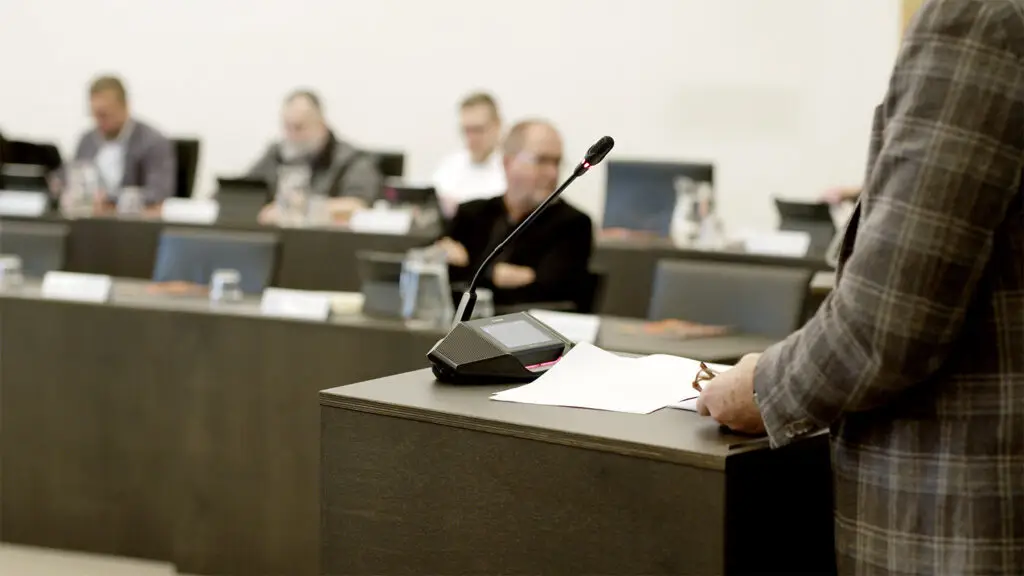
When people hear the word debating, they often picture long meetings, politicians arguing across a chamber, or experts battling over thick stacks of reports.
To be honest, that image doesn’t do debating any favors.
Because at its core, debating is much more everyday than that.
Who gets priority on that important project? Why is your idea better than the alternative? Should the team focus on speed or quality? And of course, the classic question:
“Are we really having another meeting about this?”
Debating is simply the ability to explore differences of opinion respectfully while helping others understand your perspective. Not to win an argument, but to make better decisions together.
The good news? You don’t need a lectern, a moderator, or a voting system to do it.
Whether you’re a manager, entrepreneur, colleague, or team member, a few smart debating skills can dramatically increase the chances that your ideas are heard, understood, and taken seriously.
Here are three practical tips you can start using today.
We all know that colleague.
Before the coffee has even finished brewing, they’ve already got the answer.
“We need new software.”
“We should hire another employee.”
“This entire process needs to change.”
But hold on for a second.
What problem are we actually trying to solve?
Imagine a colleague asking their manager for a new software package. They enthusiastically explain all the latest features, the improved performance, and the time-saving capabilities.
Yet the answer is still no.
Why?
Because the manager is still thinking:
“What’s actually wrong with the software we already have?”
As long as the problem remains unclear, every solution feels like a luxury rather than a necessity.
That’s why skilled debaters know one simple principle:
First the problem, then the solution.
They help others understand the frustration, risk, missed opportunity, or challenge that exists today. Only after establishing the need for change do they present their brilliant idea.
Have you ever been in a meeting like this?
The topic is a delayed project.
“We’re already three weeks behind schedule. How did this happen?” asks the project manager.
Naturally, you expect a discussion about planning, capacity, or unexpected challenges.
Then a colleague says:
“That may be true, but let’s not forget that Marketing provided incorrect figures last year.”
Another colleague immediately jumps in:
“Exactly. We had to do a lot of extra work because of that.”
And just like that, the meeting takes a sharp turn.
Thirty minutes later, everyone is discussing something that happened a year ago, and nobody has answered the original question.
Strong debaters recognize this instantly.
They understand a simple truth:
Whatever you respond to becomes the center of the conversation.
Great debaters don’t allow themselves to be pulled into endless side discussions. They acknowledge the comment and then guide the conversation back to what truly matters.
For example:
“That’s definitely something we can discuss. First, let’s understand why the current project is running behind schedule.”
This approach creates the best of both worlds.
The other person feels heard.
And the conversation stays on track.
During lunch, a colleague starts talking about a new decision from management.
“Why do we suddenly have to work with this new system? The old one worked perfectly fine.”
Maybe you’re secretly wondering the same thing.
The challenge is that you’re the manager who now has to explain the decision to the team.
Situations like this are more common than you might think.
Managers, team leaders, and employees are often expected to support decisions they didn’t personally make. A new strategy, a different process, a revised plan. Not every decision perfectly aligns with your own preferences.
So how do you handle that?
By learning to debate.
An experienced debater can build a compelling case for almost any position, even when it isn’t their personal opinion.
Give a skilled debater any viewpoint and they’ll construct a logical story supported by clear arguments.
When you develop that skill yourself, it becomes much easier to explain organizational decisions without falling back on phrases like:
“It wasn’t my choice.”
Or:
“I don’t really agree with it either.”
Instead, you can help others understand the reasoning behind the decision and what it is intended to achieve.
Good ideas have value.
Ideas that are communicated persuasively create impact.
In our Persuasive Debating training, you’ll learn how to build strong arguments, guide conversations constructively, and influence others without simply speaking louder.
Ready to have more impact on conversations, meetings, and decisions? Join the training and discover the power of persuasive debating.