


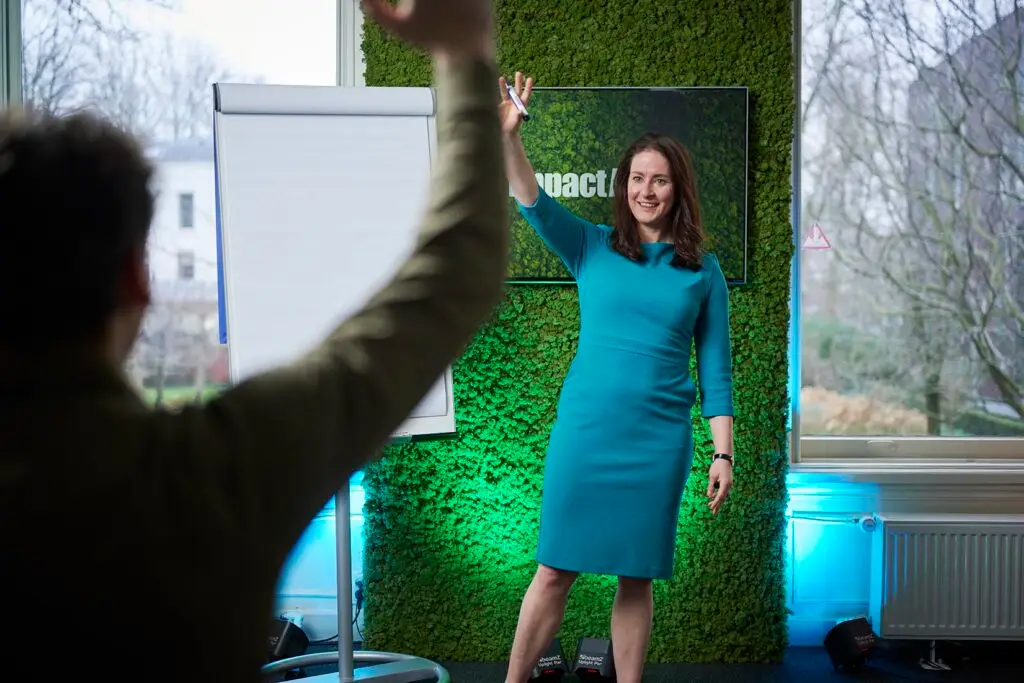
Support your teams in presenting their ideas with power, clarity, and credibility. Both verbally and non-verbally. Tailored to each participant’s style, they get personalized tips to enhance presentation skills.
Imagine this…
You have the facts. The data. The analysis. The expertise. And yet the response is underwhelming. Not because your idea is weak. But because people are not persuaded by information alone.
Many professionals believe an elevator pitch is simply a compressed explanation of what they do.
As a result, their pitch becomes a rapid-fire collection of fact; Features, Statistics, Technical details. Process descriptions, Business benefits… While these elements matter, they rarely create immediate impact.
The uncomfortable truth is that most decision-making is not purely rational.
Before people evaluate your logic, they evaluate something else:
Only then do they fully engage with your argument.
An effective elevator pitch therefore does not start with information. It starts with connection.
One of the biggest mistakes professionals make is trying to convince people.
Convincing often sounds like:
Persuasion sounds more like:
The difference is subtle but powerful. When people feel pressured, they resist. When people feel understood, they engage.
The goal of an elevator pitch is therefore not to win an argument. The goal is to spark curiosity and open a conversation.
Before people process your words, they observe you.
Your posture, eye contact, gestures, facial expressions, and energy all send signals.
Imagine two professionals saying exactly the same sentence:
One speaks while looking at the floor.
The other stands comfortably, makes eye contact, and speaks with calm confidence.
The words are identical. The impact is completely different.
Practical tip:
Confidence is often communicated non-verbally long before it is communicated verbally.
Many experts underestimate the role of emotion because they work in highly analytical environments.
Yet even in technology, healthcare, and business, decisions are ultimately made by people… And people care about outcomes.
Instead of saying:
Try:
The data matters. But the picture you paint helps people feel why the data matters. This is especially important in elevator pitches because you have limited time.
Facts explain. Emotion motivates.
Many professionals approach communication with a single style. They have their preferred way of presenting information and stick to it.
The challenge?
Not everyone communicates the same way. Some stakeholders want details. Others want the strategic vision. Some prefer direct communication. Others need context before reaching conclusions.
Great communicators learn to adjust.
They observe. They listen. They adapt. The ability to switch communication styles is one of the most powerful persuasion skills professionals can develop.
Next time you need to introduce an idea, try this structure:
What challenge does your audience recognize?
What do you help people achieve?
What improves as a result?
Short. Relevant. Memorable.
Try this simple exercise.
Record yourself pitching your idea in 60 seconds.
Then play the recording back and ask yourself:
Repeat three times.
Most people improve significantly after only a few rounds of practice.
The most persuasive professionals are rarely the ones with the most information. They are the ones who know how to connect information to people. They understand that persuasion is not about overwhelming others with facts. It is about combining clear thinking, effective communication, emotional intelligence, and adaptability.
In short, the best elevator pitches do not make people think:
They make people think:
At ImpactAll, we help professionals and teams communicate with greater clarity, confidence, and impact.
Through practical, tailor-made learning interventions in communication, influencing, public speaking, debating, stakeholder management, and strategic conversations, participants learn how to translate expertise into influence.
Whether you’re a technology company, pharmaceutical organization, or corporate team, we design learning experiences that fit your business reality.
Explore our communication and influence training programs!