
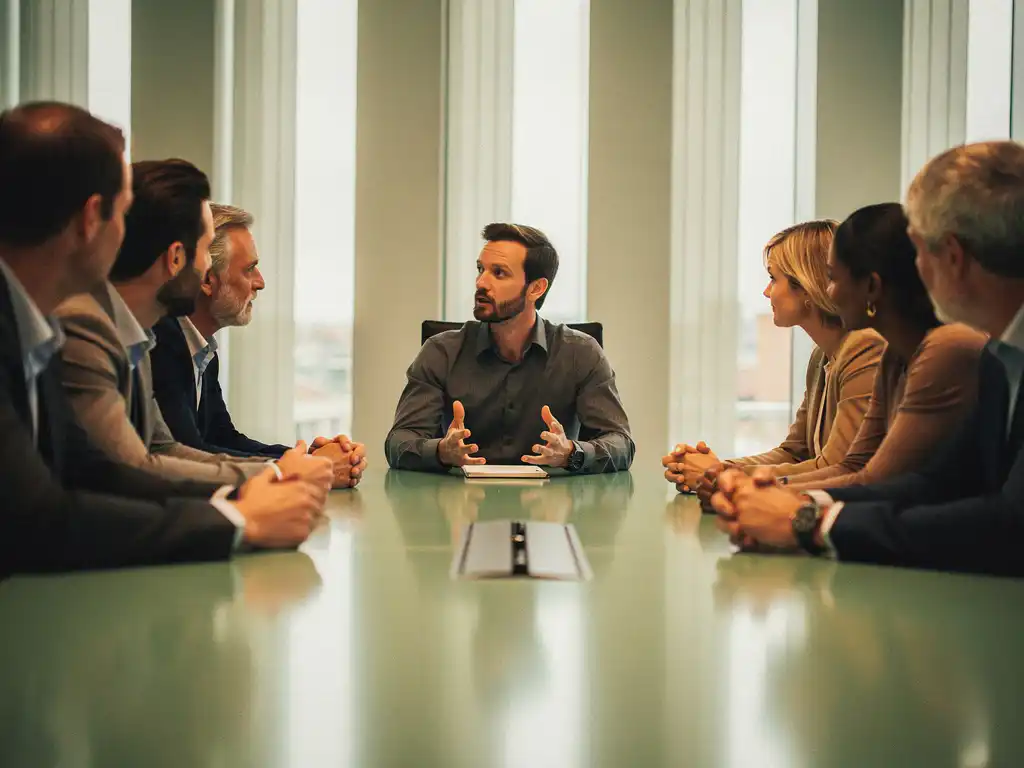
Make sure every participant has a clear role and that the meeting structure actively invites contributions — not just from the loudest voices. That is the essence of a meeting where everyone is heard. In practice, this requires deliberate choices: in structure, facilitation, and how you handle dominant or reserved participants. The questions below will guide you through this step by step.
Why do some voices go unheard in meetings?
Some voices go unheard because meetings are often unconsciously designed for people who think quickly, speak loudly, and have no trouble interrupting. Those who are more reflective, hold a less senior position, or simply communicate differently tend to disengage before they ever get a chance to say anything.
Several factors are at play. First, there is meeting culture: when it is considered normal for the most senior person in the room to do most of the talking, others automatically follow that pattern. Second, group size matters. The larger the group, the less likely quieter participants are to speak up on their own. Third, structure is often lacking: without clear speaking time or ground rules, those who naturally push themselves forward will dominate.
Miscommunication at work often begins not with what is said, but with what is not said. When certain perspectives are consistently absent, the quality of decisions declines and a sense of inequality within the team grows.
Ready to make more impact?
Develop yourself further with a training that fits your ambitions. Discover the full range of training programmes offered by ImpactAll.
View all training programmesWhat meeting structures promote equal participation?
Meeting structures that promote equal participation are those in which everyone is given an explicit opportunity to contribute, regardless of rank or personality. This requires deliberate meeting design — not just good intentions.
A few effective structures:
- Round-robin: Go around the table and give everyone a turn, without allowing interruptions.
- Silent brainstorm: Have participants write down their ideas individually before the group discussion begins. This gives more reflective thinkers the space they need.
- Empowered facilitator: Designate someone who actively monitors the balance and explicitly invites participants who have not yet spoken.
- Time limits per speaker: Limit speaking time per contribution. This prevents one person from dominating the conversation.
- Opening check-in: Start the meeting with a brief round in which everyone says something — however small. This lowers the threshold for the rest of the discussion.
Communicating effectively in a meeting context does not mean everyone speaks for the same amount of time, but that everyone has a genuine opportunity to contribute. That opportunity must be actively created.
How do you give quieter participants a voice without putting them on the spot?
You give quieter participants a voice by involving them in advance — not by surprising them in the moment. Someone who is not used to speaking up spontaneously will freeze if suddenly called upon. Preparation and psychological safety are the key words here.
A practical approach:
- Share the agenda in advance: Give people the opportunity to think about their contribution beforehand. This helps reflective thinkers enormously.
- Ask targeted questions: Instead of “Does anyone have anything to add?”, try “Marloes, what is your perspective on this point?” A specific invitation feels less arbitrary.
- Use written input: Allow participants to type their responses or ideas into a shared document or tool. This way, contributions come in without anyone having to speak aloud.
- Acknowledge contributions visibly: When someone speaks up, explicitly recognize what they said. This encourages them to do so again.
Communicating clearly as a facilitator also means giving space non-verbally: eye contact, an open posture, and a brief pause after a question all invite participation without creating pressure. One-on-one coaching for communication skills can help participants further develop these kinds of skills outside of meetings as well.
What can you do when one person dominates the conversation?
When one person dominates the conversation, stepping in as a facilitator is not rude — it is necessary. Dominance in meetings is rarely intentional, but the effect is always the same: other voices fade into the background and the quality of the discussion suffers.
What works in practice:
- Interrupt politely but clearly: “I’m going to pause you there so we can hear from others as well.” Say it calmly and without apologizing.
- Refer back to the structure: “We agreed that everyone would speak for a maximum of two minutes. Let’s stick to that.”
- Address the person afterward: If the pattern is recurring, discuss it outside the meeting. Give concrete feedback about the impact of the behavior — not about the person themselves.
- Name it in the group: In some cases, it helps to make the dynamic visible: “I notice that a few people haven’t had a chance to speak yet. Let’s change that.”
Resolving communication issues in meetings sometimes takes courage. But a facilitator who does not intervene is implicitly giving the dominant voice permission to continue.
How do you measure whether a meeting was truly inclusive?
A meeting was truly inclusive when everyone not only had the opportunity to speak, but also felt that their contribution genuinely mattered. That is harder to measure than speaking time, but it is not impossible.
Ways to evaluate inclusivity:
- Brief closing round: Ask everyone to share in one sentence how they experienced the meeting. Those who said nothing during the meeting can say something now.
- Anonymous feedback: Use a simple form or tool that allows participants to indicate whether they felt heard.
- Speaking time analysis: Keep track of who spoke and for how long. It does not need to be precise — even a rough breakdown provides useful insight.
- Trace decision-making: Look back afterward at which contributions actually influenced the decisions made. If the same voices consistently carry the most weight, something is structurally wrong.
Effective non-verbal communication also plays a role in inclusivity: a facilitator who avoids eye contact with certain participants is unconsciously excluding them. Awareness of these kinds of signals is a first step toward improvement.
How ImpactAll helps with inclusive meetings and effective communication
Inclusive meeting facilitation is a skill, not a personality trait. The good news: it can be learned. ImpactAll trains teams and facilitators in exactly the skills that make the difference:
- Conscious awareness of group dynamics and non-verbal signals
- Techniques for actively involving everyone without losing control of the meeting
- Clear and direct communication, even in challenging conversations
- Strengthening personal style so that participants can remain true to themselves
The training programs are practice-oriented and fully tailored to the context of your organization — whether that is a management team, a municipal council group, or a healthcare department. Want to find out what ImpactAll can do for your team? Get in touch or request a session directly.
Frequently Asked Questions
How long does it take for inclusive meeting structures to truly stick in a team?
This varies by team, but expect at least four to six weeks of conscious practice before new habits become second nature. It helps to take a few minutes after each meeting to reflect on what went well and what could be improved. Structural change requires repetition and consistency — not a one-time intervention.
What if the dominant speaker is the manager themselves?
This is a common and sensitive situation. A good approach is to let the meeting structure do the work: agree in advance that everyone gets a fixed amount of speaking time, including the manager. If that does not work, an external facilitator can provide a solution. In some cases, an open conversation with the manager outside of the meeting is the most effective route.
Are there digital tools that support inclusive meetings?
Yes, there are several tools that help promote equal participation. Consider Mentimeter or Slido for anonymous input and live polls, Miro for collaborative visual brainstorming, and simple shared documents such as Google Docs for written contributions before or during the meeting. What matters is not which tool you use, but that the tool makes it possible for people who are less confident speaking aloud to contribute.
How do you handle resistance from participants when introducing new meeting structures?
Resistance often arises because people are used to the existing dynamic, or because the new structure feels artificial. Always explain the purpose: not rules for the sake of rules, but more valuable contributions from everyone. Start small — for example, with just a check-in or a silent brainstorm — so participants can experience that it works without the entire meeting being turned upside down.
What are common mistakes when trying to run inclusive meetings?
A common mistake is that facilitators have the intention to involve everyone, but forget to adjust the structure accordingly. Good intentions without a concrete approach change very little. Another pitfall is randomly calling on quiet participants without preparing them first, which tends to backfire. Finally, inclusivity is often measured by speaking time alone, when what ultimately matters is whether contributions actually influence decisions.
How do you make inclusive meetings work in hybrid or online settings?
In hybrid and online meetings, the barrier to speaking up is even higher than in in-person settings. Make sure you have a clear speaking order and treat the chat function as a fully valid way to contribute. Explicitly acknowledge participants who are joining remotely and actively invite them to speak — they are much easier to overlook in a physical room. Tools such as breakout rooms can also help people contribute in smaller groups.
Can inclusive meetings lead to better decisions, or do they just take more time?
Research consistently shows that diverse and inclusive decision-making leads to higher-quality outcomes, because more perspectives help fill in blind spots. The time investment is mainly upfront: a well-prepared, structured meeting does not take longer — it simply delivers more. Teams that run inclusive meetings also report higher levels of engagement and less need for follow-up discussions afterward.