
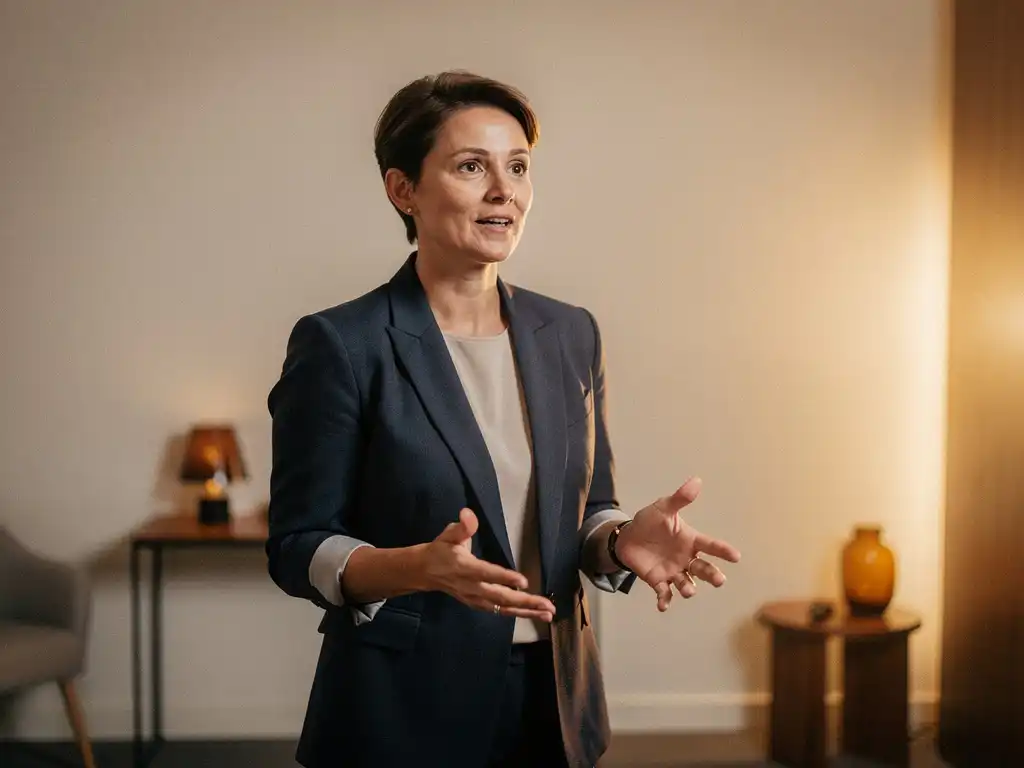
Effective non-verbal communication is characterized by consistency, awareness, and adaptability. It is about the alignment between what you say and how you say it — through posture, facial expression, eye contact, tone of voice, and gestures. Those who use these elements deliberately enhance their credibility and prevent miscommunication in the workplace. In this article, we answer the most frequently asked questions about non-verbal communication and what you can practically do with it.
What elements make non-verbal communication effective?
Non-verbal communication is effective when the various signals you send reinforce one another and align with your verbal message. The key lies in congruence: your words, posture, and tone of voice must form a unified whole. When that alignment is missing, the receiver tends to trust the non-verbal signal over the spoken words.
The most important elements that make non-verbal communication effective are:
- Posture: An open, upright posture conveys confidence and invites the other person to engage.
- Eye contact: Consistent but not staring eye contact demonstrates involvement and sincerity.
- Facial expression: The emotions you express must match the tone of the conversation.
- Gestures: Supportive hand movements clarify and enliven your message.
- Tone of voice: Pace, volume, and pitch all influence how a message comes across.
- Use of space: The distance you maintain from others affects whether you come across as approachable or dominant.
Each of these elements contributes to effective non-verbal communication. But they are never isolated tricks. They only work sustainably when they fit your natural style and the context of the conversation.
Klaar om meer impact te maken?
Ontwikkel jezelf verder met een training die past bij jouw ambities. Ontdek het volledige trainingsaanbod van ImpactAll.
Bekijk alle trainingenHow does body language affect the credibility of a message?
Body language affects the credibility of a message because people unconsciously give more weight to non-verbal signals than to spoken words. When someone claims to be confident but keeps their shoulders hunched and looks away, the receiver immediately picks up on the contradiction — even without consciously naming it.
Credibility is built through a combination of factors. A stable, open posture signals that you stand behind what you are saying. Calm, controlled breathing produces a steady voice, which projects authority. Maintaining eye contact shows that you take the other person seriously and are not shying away from the message.
Conversely, closed body language — such as crossed arms, lack of eye contact, or restless movement — undermines the listener’s trust. In professional contexts such as presentations, negotiations, or leadership conversations, this can make the difference between persuading and sowing doubt. Communicating effectively therefore requires conscious attention to your non-verbal presence, not just the content of your words.
What is the difference between conscious and unconscious non-verbal signals?
Conscious non-verbal signals are behaviors you deliberately use to create a certain impression — such as standing up straight before a presentation or intentionally smiling during an introduction. Unconscious signals are automatic responses to emotions or tension, such as a clenched jaw, speaking more quickly, or looking away when faced with a difficult question.
The distinction matters because unconscious signals often say more than conscious ones. It is precisely the small, unplanned movements — a slight frown, a hesitation in the voice, a step backward — that conversation partners pick up on as authentic information about what someone truly feels or thinks.
Anyone who wants to improve their non-verbal communication starts with becoming aware of their own unconscious patterns. This requires practice and reflection, ideally with external feedback. Only once you know which signals you are sending unintentionally can you adjust them without coming across as inauthentic.
How do you adapt non-verbal communication to different contexts?
Adapting non-verbal communication to context means adjusting your behavior to the situation, the relationship, and the expectations of the person you are speaking with. What works in an informal team meeting does not necessarily work in a boardroom or in front of a large audience. Context sensitivity is a core skill in communicating clearly.
A few guidelines can help:
- Read the room: In formal settings, your posture calls for greater restraint and precision. In informal conversations, a more relaxed approach is appropriate.
- Match your energy: When addressing a large group, greater expressiveness in your voice and gestures strengthens your message. In a one-on-one conversation, subtlety works better.
- Be mindful of cultural differences: Eye contact, personal space, and gestures are interpreted differently across cultures.
- Adjust your pace: In tense situations, such as delivering difficult news, a calm pace has a reassuring effect. In an energetic presentation, varying your pace keeps the audience engaged.
- Be consistent: Whatever the context, the fundamental rule remains: make sure your non-verbal behavior matches what you are saying.
Adapting does not mean becoming a different person. It means consciously choosing which aspects of your communication style to bring forward in a given situation.
Why do non-verbal skills often lag behind verbal skills?
Non-verbal skills lag behind verbal skills because from an early age we are trained in language, but rarely in body language. At school you learn to write, speak, and argue. How you stand, move, or look receives almost no attention — even though it accounts for a large part of overall communication.
Added to this is the fact that non-verbal behavior is largely unconscious. Verbal communication can be planned and practiced. Non-verbal signals slip more easily out of conscious control, especially under pressure or stress. And it is precisely in the situations that matter most — a job interview, a presentation, or a difficult conversation — that non-verbal skills are the first to falter.
Another factor is that people rarely receive direct feedback on their non-verbal behavior. Colleagues are more likely to comment on the content of a presentation than on how someone stood or sounded. As a result, blind spots can persist for a long time. Resolving communication problems therefore often begins with making those blind spots visible — through coaching, video recordings, or targeted training. Structured learning environments, such as those offered through the ImpactAll communication training programs, are specifically designed to address these gaps and help professionals develop lasting non-verbal skills.
How ImpactAll helps with non-verbal communication
ImpactAll supports professionals and organizations in developing strong non-verbal skills as part of a broader communication profile. This is not done through isolated tips, but through an approach tailored to each participant’s personal style. Specifically, ImpactAll offers:
- In-company training focused on presentation technique, voice use, posture, and persuasiveness
- Individual communication coaching for professionals who want to work specifically on their non-verbal presence
- Programs such as Presenting with Impact and Conscious Influence, tailored to each participant’s specific context
- Guidance from experienced trainers with backgrounds in psychology, performance, and influencing skills
Training sessions take place at the Nieuwegracht location in Utrecht, at the client’s premises, or online. Want to find out what ImpactAll can do for you or your organization? Get in touch or request a coaching program directly.
Frequently Asked Questions
How long does it take to see a noticeable improvement in non-verbal communication?
The speed of improvement depends on how deliberately you work at it. With focused practice and regular feedback, you can experience noticeable changes in specific situations — such as presentations or meetings — within a matter of weeks. Lasting improvement, where new behaviors become automatic even under pressure, typically requires several months of consistent practice and reflection. A coach or training program can significantly accelerate this process by providing direct, targeted feedback on your blind spots.
What are the most common non-verbal mistakes professionals make?
The most common mistakes are: maintaining too little or too rigid eye contact, adopting a closed posture (arms crossed, shoulders pulled in) in situations that call for openness, and using a monotone voice that undermines listener engagement. Many professionals also underestimate the impact of restless movements — such as fidgeting, swaying, or over-gesturing — which create distraction and project insecurity. Recognizing your own recurring patterns is the first step toward improvement.
How do you handle non-verbal communication during online video calls?
In video calls, the dynamics shift: the camera replaces eye contact, which means looking into the lens rather than at the screen is crucial for coming across as engaged. Make sure you have a neutral, well-lit background and position your camera at eye level to create an equal, confident impression. Your voice and facial expressions carry extra weight online because the rest of your body language is largely invisible, so invest deliberately in varying your tone and pace. A calm, stable posture and intentional pauses in your speech significantly boost your credibility in digital settings.
Can you learn to read other people's non-verbal signals without drawing the wrong conclusions?
Yes, but it requires caution: a single non-verbal signal says very little — it is always about clusters of behaviors in the right context. Someone crossing their arms may simply be cold rather than being defensive. Train yourself to recognize patterns, and always ask yourself whether the signals are consistent with the situation and the person. A good rule of thumb is: observe first, interpret later, and if in doubt, test your interpretation by asking an open question.
What can I do concretely if I notice that my body language does not match what I want to convey?
Start by keeping a brief reflection log after important conversations or presentations: note which moments felt right and which did not, and link those observations to your non-verbal behavior. Make use of video recordings of yourself during practice sessions or presentations, because what you feel and what you project often differ more than you expect. Also actively seek feedback from a trusted colleague or manager on specific behaviors — not just on the general impression you made. For structural improvement, working with a communication coach is the most effective route, as they can quickly and precisely identify your blind spots.
Are there cultural differences in non-verbal communication that I should be aware of in an international work environment?
Absolutely. Eye contact that is seen as engaged and honest in the Netherlands can be perceived as disrespectful or confrontational in some Asian cultures. Personal space, the degree of physical contact such as a handshake or a pat on the shoulder, and the meaning of a smile vary considerably across cultures. In international work environments, it is wise to research the communication norms of your counterparts in advance and to start by being reserved and observant before fully applying your own style. Adaptability and cultural sensitivity are therefore inseparably linked to effective non-verbal communication.
Is non-verbal communication learned, or does it depend heavily on personality?
Both play a role: personality influences your natural communication style, but non-verbal skills are largely learned and trainable. An introverted person does not suddenly need to display extroverted behavior, but can learn how to convey their engagement and confidence more powerfully through non-verbal means in a way that feels authentic to them. The key is not to copy someone else’s behavior, but to strengthen your own authentic style with conscious, effective non-verbal choices. It is precisely that combination of authenticity and skill that makes communication sustainably persuasive.
Ready to take your non-verbal communication to the next level? Contact ImpactAll today and discover which training or coaching program best fits your goals.